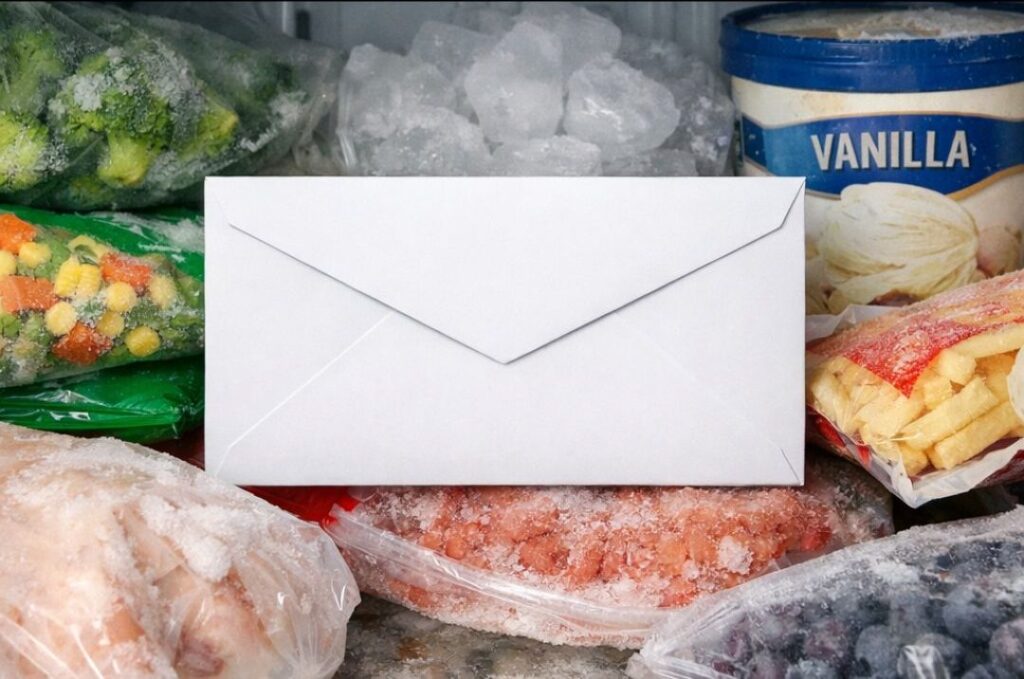
Why People Put an Envelope in the Freezer

The Science Behind the Chill
Most traditional envelopes use dextrin-based adhesive—a starch glue activated by moisture (that’s the “lick-and-seal” kind). When wet, it flows into paper fibers. As it dries, it hardens into a flexible bond.
Freezing doesn’t melt this glue. Instead, cold makes it brittle. The adhesive loses pliability, its grip on the paper fibers weakens, and—when handled gently—the seal releases like a sigh.
Important note: This only works on water-activated adhesives. Modern “peel-and-stick” envelopes use pressure-sensitive synthetic glues that laugh at freezer temperatures. If your envelope didn’t require saliva to seal, the freezer won’t help.
When It Works Best (And When It Won’t)
Your odds improve if:
→ The envelope uses classic lick-and-seal adhesive (matte finish, not glossy tape-strip)
→ It was sealed recently (within 24–48 hours)
→ You applied just enough moisture—not a soggy drench
→ The paper is substantial (not tissue-thin or foil-like)
→ The envelope uses classic lick-and-seal adhesive (matte finish, not glossy tape-strip)
→ It was sealed recently (within 24–48 hours)
→ You applied just enough moisture—not a soggy drench
→ The paper is substantial (not tissue-thin or foil-like)
It likely won’t work if:
→ It’s a peel-and-stick envelope (common on utility bills or pre-paid return mailers)
→ You pressed the seal with excessive force (glue seeped deep into fibers)
→ Days or weeks have passed (bond has fully cured)
→ It’s a peel-and-stick envelope (common on utility bills or pre-paid return mailers)
→ You pressed the seal with excessive force (glue seeped deep into fibers)
→ Days or weeks have passed (bond has fully cured)